 Written by
Many teachers spend as many as ten hours per week on marking alone, with 95% of teachers doing it at home. Cutting down on grading time goes beyond simple time management. It requires structural changes to years of inefficient assessment design. With the help of visible assessment, teachers can avoid that daunting weekend pile without compromising their attention to each individual student.

What Visible Assessment Means
Visible assessment is a teaching model in which students collaborate on a large, shared physical canvas, moving away from private notebooks. It’s among the best strategies for better learning outcomes, as teachers can instantly identify any misconceptions or errors in the classroom. This powers course correction while teaching instead of leaving errors undiscovered for days.
In short, public canvases enable teachers to provide students with valuable, formative feedback during paid hours, preserving your weekend free time.
Supporting the idea of visible assessment is educationalist Dylan Wiliam’s research on responsive teaching and formative assessment. Wiliam concluded that formative assessment is one of the most effective teaching methods because it focuses on teaching based on what the learner already knows. Wiliam also found that the best way to perform formative assessment is to always check if students understand a topic while working with all students. This method is something visible assessment can achieve in the classroom.
In addition, Harvard Graduate School of Education’s Project Zero framework shows how visible assessment can improve teacher work conditions and student learning. Specifically, this framework involves establishing “Making Thinking Visible” routines in K-12 classrooms. The idea is that teachers can do their job even better when they can figure out precisely how their students think, which ties into formative assessment.
To help you get the most from visible formative assessment, you may want to implement visual workspaces that allow students to work together.
Shared Visual Workspaces Make Learning More Teachable
Large shared visual boards support both project-based and STEM learning, making “thinking visible” for more proactive assessment during teaching hours.
Using these collaborative workspaces, educators can more easily assess group dynamics, whole-class trends in thinking, and individual understanding all at once. As a result, complex pedagogies become highly teachable, improving teacher work conditions by eliminating the need for hours spent on weekend marking.
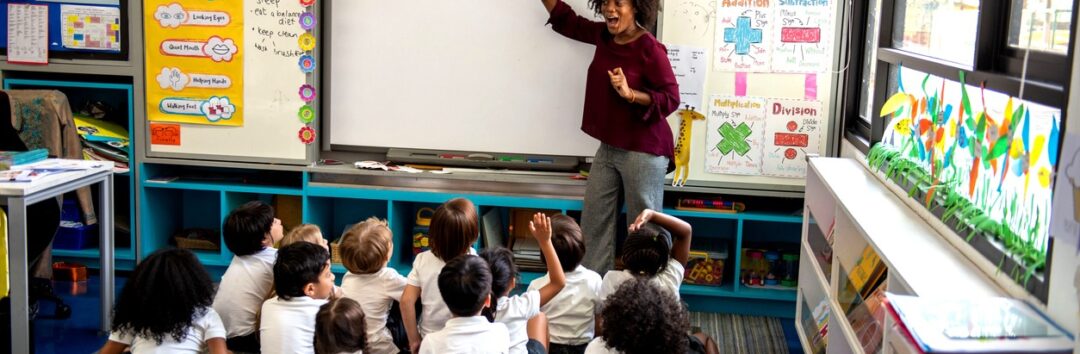
Teachers can ask questions in class, allowing students to contribute their thoughts to the board and giving you a complete picture of the class at a glance. In turn, you no longer need to assess one student at a time. At the same time, each student still gets the attention he or she needs for proper assessment.
Here are some of the specific benefits of visible assessment using a physical board:
- Real-Time Progress Tracking: While teaching, educators can see students brainstorm ideas, sketch drawings, or add notes actively in the classroom. At any point during this process, teachers can more easily see where students get stuck or struggle to understand concepts before grading takes place.
- Seeing the Process: When students complete work on their own and teachers only see the results days later while marking, educators may not see how or why the students arrived at the wrong answer. Visible, shared boards in the classroom can fix this. For instance, a student might write the correct steps in a math problem but still get the answer wrong, in which case the teacher could pinpoint the mistake and correct it on the spot.
- Personalised Feedback: Boards allow teachers to leave comments, stickers, or annotations on ideas or drawings, much the same way they would when marking work later.
School Leaders Should Treat Visual Learning Infrastructure as a Capability
When looking for the right strategies for better learning outcomes, leaders should find visible assessment to be a core teaching capability, not an administrative expense. The creation of visual resources on demand can give educators the kind of support they need for better teacher work conditions.
Instead of becoming fatigued after long periods of grading, teachers will be more energised and capable of meeting each student’s unique needs with invaluable visual boards. Subsequently, schools benefit from increased teacher retention and agility, which ultimately leads to better student outcomes.
These advantages make it crucial for school leaders to invest in the operational ability to generate large, shared learning canvases in-house. These investments include large-format printers and high-quality print materials that foster a shared workspace and visible assessment.
Investing in this equipment ultimately translates into a direct investment in teacher well-being as well as the school’s overall operational efficiency. Also, purchasing the right printers and materials can prevent potentially costly breakdowns and keep printing operations profitable in the end.
What Schools Need to Make Visible Assessment Practical
As educators seek both better teacher work conditions and reliable strategies for better learning outcomes, it’s important to modernise the assessment process.
Updating assessment today means breaking down private workflows for both students and teachers. When both can work with each other in the classroom, students can get a better handle on the topics they learn, while teachers can learn how students think to continually optimise their own teaching methods while developing students individually. Educators won’t be in the dark regarding why or how a student is struggling, and they can free up more time to restore their energy, which makes for more present teaching.
All of these advantages show just how moving away from individualised paper assessment toward large-format visual learning materials isn’t a mere trend. Instead, it’s a necessary evolution of operational standards to create a sustainable model for schooling. With large, top-quality visual collaboration boards, students can benefit from a more engaged learning experience that helps them grow, while teachers gain deeper insights into individuals and groups, and leaders see an overall school-wide improvement with content and efficient teachers, along with a student body equipped for meaningful education.
This article was developed in partnership with HP. Together, we explore the future of innovation, from advanced printing solutions to seamless collaboration tools. Equip yourself with HP to achieve your best work.