 Written by
 How We Evaluated These Accounting Software Platforms
We tested and reviewed each accounting software platform based on five criteria. Those criteria are ZATCA Phase 2 compliance, Arabic RTL support, feature depth, real-world user ratings, and value for money.
Pricing data was verified directly from vendor websites in June 2026. User ratings are sourced from G2 and Capterra where available.
We also consulted ZATCA’s official technical documentation at zatca.gov.sa to verify compliance requirements.
This guide covers the top 12 global platforms plus 2 Saudi-native platforms — Wafeq and Qoyod. Saudi-native options are purpose-built for the local market and are rapidly gaining adoption among KSA SMEs.
Why Accounting Software Is Now a Legal Requirement in Saudi Arabia
ZATCA (Zakat, Tax and Customs Authority) made e-invoicing mandatory for all VAT-registered businesses. This is not optional. It is the law.
As of 2026, Phase 2 (Integration Phase) is live for most Saudi enterprises. Non-compliant businesses face fines from SAR 5,000 to SAR 50,000 per violation.
Vision 2030 is pushing the entire Saudi economy toward digital financial systems. Businesses that use manual or non-compliant tools are falling behind.
The right accounting software in KSA solves three problems at once. It keeps you ZATCA-compliant, automates your VAT reporting, and makes your financial records audit-ready.
| ⚠️ Are You Required to Comply with ZATCA Phase 2? ZATCA notifies businesses by wave, based on annual VAT-subject revenue. If your business has already received a Phase 2 notification, compliance is mandatory now. If you have not yet been notified, prepare in advance — all VAT-registered businesses will eventually be included. Visit zatca.gov.sa for the current wave schedule and your specific compliance deadline. |
Why Saudi Businesses Need Specialized Accounting Software
Generic global accounting tools were not designed for Saudi Arabia. They often miss critical local requirements.
Here is what any accounting or bookkeeping software in KSA must support:
- ZATCA Phase 2 e-invoicing: Real-time API connection to FATOORA portal, UBL 2.1 XML format, cryptographic CSID stamp, and QR code on every invoice.
- 15% VAT compliance: Automatic VAT calculation, input/output VAT tracking, and VAT return reports. Saudi Arabia raised VAT to 15% in July 2020.
- Arabic RTL support: Full right-to-left interface and Arabic invoice generation — not just a translated menu.
- GOSI payroll compliance: Automatic GOSI contribution calculations and WPS (Wage Protection System) integration for salary payments.
- Multi-currency support: Many Saudi businesses trade in USD, EUR, and other GCC currencies daily.
- Audit-ready records: ZATCA and Zakat Authority audits can happen at any time. Your records must be complete and easy to retrieve.
Using spreadsheets or non-compliant tools is a legal and financial risk. The right software removes that risk entirely.
Key Features to Look For in Saudi Accounting Software
1. ZATCA Phase 2 E-Invoicing
This is the most important feature for any VAT-registered business in KSA. Look for native integration — not a third-party workaround. Native compliance means the software connects directly to the FATOORA portal without any middleware.
2. Automated VAT Management
Your software must apply 15% VAT automatically. It should also track input and output VAT separately and produce VAT return reports in the ZATCA-approved format.
3. Full Arabic RTL Interface
Arabic support must go beyond translated menus. Look for full right-to-left invoice generation, Arabic financial reports, and bilingual document output.
4. Real-Time Financial Reporting
You need access to profit and loss, balance sheet, cash flow, and accounts receivable reports at any time — not just at month-end.
5. Saudi Payroll Compliance
Look for GOSI calculation automation, end-of-service benefit provisions, and WPS salary disbursement integration. These are legal requirements for businesses with Saudi employees.
6. Cloud-First Architecture
Cloud accounting software receives automatic ZATCA compliance updates. On-premise software requires your IT team to deploy updates manually. For a regulatory environment that changes frequently, cloud is safer.
7. Scalability
Choose software that grows with your business. You should not need to change platforms when you hire more staff or open a new branch.
12 Best Accounting Software in Saudi Arabia (2026)
Each platform below has been evaluated on ZATCA readiness, Arabic support, features, user ratings, and pricing. We have included the two leading Saudi-native platforms as an essential addition to the standard global list.
1. QuickBooks Online
The World’s Most-Used Accounting Platform — Now with Saudi Localization
Best For: SMEs | Consultants | Growing Businesses | G2 Rating: 4.5/5 (2,900+ reviews)
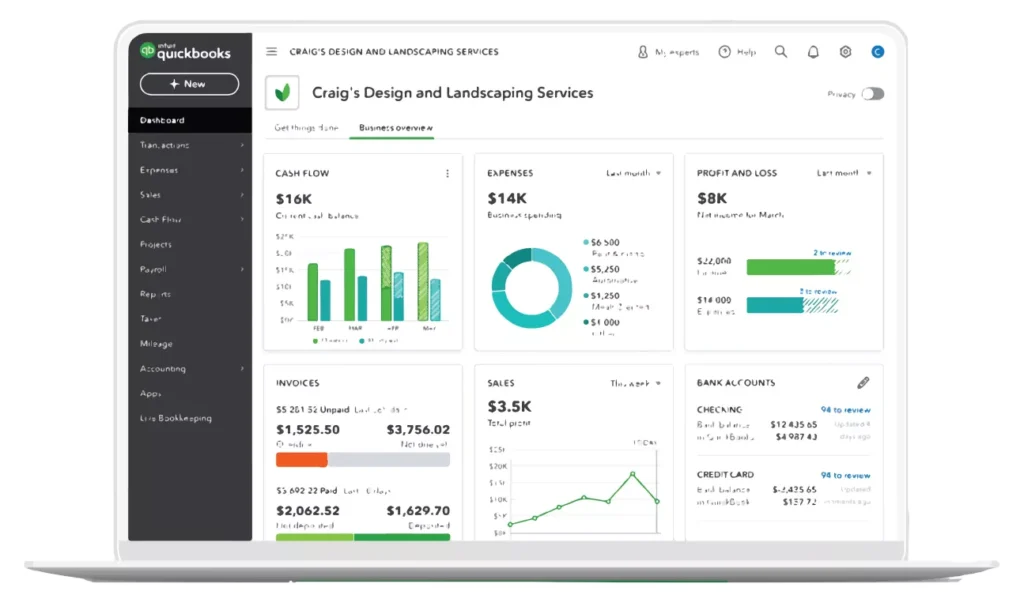
QuickBooks Online is the most widely used accounting software in the world. It works well for Saudi SMEs. ZATCA Phase 2 compliance requires a certified third-party connector — it is not native. Setup takes effort but the result is a fully compliant system with a familiar, easy-to-use interface.
Key Features
- Expense tracking with automatic bank feed categorization
- Invoice management with VAT line-item support
- P&L, balance sheet, and cash flow reports
- Bank reconciliation with real-time transaction matching
- Cash flow forecasting dashboard
- 750+ third-party app integrations
- Mobile app for iPhone and Android
✅ Advantages
- Very easy to use — short learning curve
- Strong reporting with drill-down details
- Large global community of accountants familiar with it
- Wide integration ecosystem
⚠️ Considerations
- ZATCA Phase 2 requires third-party setup — not native compliance
- Arabic RTL support is limited vs Saudi-native platforms
- Local implementation partner recommended for full KSA setup
Best For: SMEs, growing businesses, and firms whose accountants already use QuickBooks.
Pricing: Starts from SAR 75–150/month. Contact QuickBooks for current KSA pricing.
2. SAP Business One
Enterprise ERP and Accounting for Mid-Sized Saudi Businesses
Best For: Mid-Sized Companies | Manufacturing | Distribution | G2 Rating: 4.3/5 (600+ reviews)
SAP Business One is one of the most trusted ERP platforms in Saudi Arabia. It has a large network of certified implementation partners across the Kingdom. The Saudi-localized edition natively supports ZATCA Phase 2, Arabic documentation, and VAT compliance. It is a full business management system — not just an accounting tool.
Key Features
- Full ZATCA Phase 2 compliance via SAP-certified Saudi localization
- Financial management — AP, AR, GL, and cost center accounting
- Supply chain and inventory with warehouse tracking
- CRM integration for sales and customer management
- Advanced analytics and reporting dashboards
- Manufacturing bill-of-materials and production orders
- Multi-currency and multi-company support
✅ Advantages
- Native ZATCA Phase 2 compliance through certified local partners
- Scales from 10 to 1,000+ users
- Strong Saudi implementation partner network
- Full ERP — goes far beyond basic accounting
⚠️ Considerations
- Higher cost than SME-focused tools
- Requires a skilled implementation partner — not self-setup
- Ongoing support needs internal IT or managed services
Best For: Mid-sized manufacturing, trading, and distribution companies needing full ERP with Saudi compliance.
Pricing: Licensing from SAR 1,500–3,000/month. Implementation costs vary by partner.
3. Oracle NetSuite ERP
The Cloud ERP for Large Saudi Enterprises and Multi-Location Businesses
Best For: Large Enterprises | Multi-Location | International Organizations | G2 Rating: 4.0/5 (1,400+ reviews)
Oracle NetSuite is the leading cloud ERP for large businesses worldwide. It combines accounting, CRM, inventory, and e-commerce in one platform. For Saudi Arabia, ZATCA e-invoicing and VAT compliance are available through the KSA localization module. It gives finance leaders real-time dashboards across every part of the business.
Key Features
- Unified cloud ERP — accounting, CRM, inventory, and BI in one platform
- ZATCA e-invoicing via KSA localization module
- Advanced financial planning with scenario modeling
- Multi-currency, multi-entity, and multi-language accounting
- Role-based real-time KPI dashboards
- Revenue recognition and deferred revenue automation
- API-first architecture for third-party integrations
✅ Advantages
- Single platform eliminates the need for multiple systems
- Strong automation reduces manual financial work
- Excellent global and regional compliance coverage
- Real-time reporting for large, complex organizations
⚠️ Considerations
- High cost — not suited for SMEs
- Implementation takes 3 to 6 months with specialist consultants
- Complexity can overwhelm teams new to ERP
Best For: Large Saudi enterprises, multi-location businesses, and international organizations.
Pricing: Annual contract typically starts from SAR 60,000+. Contact Oracle for a tailored quote.
4. TallyPrime
The Trusted Accounting Workhorse for Saudi SMEs and Trading Firms
Best For: SMEs | Trading Companies | Retail Businesses | Capterra Rating: 4.2/5 (500+ reviews)
TallyPrime has been used across Saudi Arabia and the GCC for over two decades. It is most popular among trading companies and retail businesses. Its strengths are reliable accounting and strong inventory management. For ZATCA Phase 2 API integration, verify the current compliance status with your local Tally partner before purchasing.
Key Features
- Multi-company accounting management
- Inventory with batch, expiry, and serial number tracking
- VAT management with automated calculations
- Bank reconciliation and payment management
- Payroll with statutory compliance support
- Balance sheet, P&L, and cash flow reports
- Role-based data access controls
✅ Advantages
- Proven and reliable — trusted by thousands of Saudi businesses
- Excellent inventory management for trading and retail
- Easy to learn — short training period
- Cost-effective for budget-conscious SMEs
⚠️ Considerations
- Cloud capabilities are limited vs cloud-native platforms
- ZATCA Phase 2 API compliance — verify with your local Tally partner
- Mobile access less advanced than newer SaaS platforms
Best For: Small and medium businesses, trading companies, and retailers with high inventory volume.
Pricing: Perpetual license from SAR 1,800–4,500. Annual maintenance charges apply.
5. FreshBooks
The Simplest Invoicing and Accounting Tool for Saudi Freelancers
Best For: Freelancers | Agencies | Professional Service Providers | G2 Rating: 4.5/5 (4,300+ reviews)
FreshBooks is designed for service businesses, freelancers, and consultants. It makes invoicing, time tracking, and expense management very simple. You do not need an accounting background to use it. For VAT-registered businesses requiring ZATCA Phase 2 integration, additional configuration is needed. FreshBooks is best for early-stage service businesses not yet in Phase 2.
Key Features
- Professional invoicing with automated payment reminders
- Time tracking linked directly to client billing
- Expense management with receipt capture
- Client portal for payment and communication
- P&L and expense reports
- Project profitability tracking for agencies
- Mobile app with offline capability
✅ Advantages
- The cleanest, easiest interface in this list
- Excellent client communication and invoicing experience
- Great for hourly billing or project-based billing
- Affordable for solo professionals and small teams
⚠️ Considerations
- Not designed for inventory-heavy businesses
- ZATCA Phase 2 requires extra setup — not native
- Limited scalability for businesses needing full ERP
Best For: Freelancers, consultants, agencies, and service businesses in Saudi Arabia’s growing gig economy.
Pricing: Starts from SAR 80/month. Lite, Plus, Premium, and Select plans available.
6. Xero
The Modern Cloud Accounting Platform for Digital-First Saudi Businesses
Best For: Startups | Small Businesses | Digital-First Companies | G2 Rating: 4.3/5 (3,000+ reviews)
Xero is a modern, cloud-native accounting platform. It is popular with startups and tech-savvy small businesses. Its automated bank reconciliation saves hours of manual work each month. For Saudi Arabia, ZATCA Phase 2 compliance requires supplementary local tools. Xero is best suited for businesses that prioritize clean UX and automation.
Key Features
- Automated bank reconciliation with smart transaction matching
- Real-time financial dashboards with performance insights
- Inventory management and purchase order tracking
- Project and job tracking with profitability reporting
- Expense management with receipt capture
- 1,000+ third-party app integrations
- Multi-user access for owners and external accountants
✅ Advantages
- Modern, clean interface encourages daily use
- Excellent bank feed automation reduces manual entry
- Strong collaborative access for businesses using external accountants
- Constantly updated with new compliance features
⚠️ Considerations
- ZATCA Phase 2 requires local supplementary tools
- Native Arabic RTL support less developed than Saudi platforms
- May need local implementation partner for KSA VAT setup
Best For: Startups, digital-first SMEs, and businesses that value modern UX over deep local compliance features.
Pricing: Starts from SAR 90/month. Starter, Standard, and Premium plans available.
7. Sage 50 Accounting
The Reliable Accounting Solution for Saudi SMEs with Strong Financial Controls
Best For: Small and Medium-Sized Businesses | Professional Services | Multi-Industry | Capterra Rating: 4.1/5 (700+ reviews)
Sage 50 is a stable, proven accounting platform used by SMEs worldwide. It offers strong financial controls and reliable bookkeeping. In Saudi Arabia, it supports VAT management and connects to ZATCA-compliant e-invoicing tools through integration options. It is a solid choice for businesses that value stability over cutting-edge features.
Key Features
- Comprehensive general ledger management
- VAT management with automated calculations
- Inventory tracking with stock valuation and reorder alerts
- Bank reconciliation with transaction matching
- Payroll integration with leave and benefit tracking
- AP and AR management
- Customizable financial reporting
✅ Advantages
- Proven, stable platform across multiple industries
- Strong financial controls and audit trail
- Reliable VAT management for Saudi compliance
- Good balance of features and price
⚠️ Considerations
- ZATCA Phase 2 native integration needs a third-party connector
- Interface is less modern than cloud-native competitors
- Cloud functionality less advanced than full SaaS platforms
Best For: Small and medium businesses needing a proven, stable accounting platform with strong financial controls.
Pricing: Annual subscription. Contact Sage or an authorized Saudi reseller for current KSA pricing.
8. Odoo Accounting
The Open-Source ERP with Full Saudi Localization
Best For: Growing Businesses | ERP-Seeking Companies | Tech-Savvy Organizations | G2 Rating: 4.2/5 (800+ reviews)
Odoo is an open-source ERP platform with accounting as one of many modules. It natively supports ZATCA e-invoicing and full Arabic RTL — making it one of the most localized global platforms for Saudi Arabia. You can start with accounting only and add CRM, HR, inventory, and manufacturing modules as you grow. No platform change needed.
Key Features
- Native ZATCA-compliant e-invoicing with Arabic RTL support
- Automated invoicing with recurring billing
- Full multi-warehouse inventory management
- CRM integration connecting sales and financial data
- Purchase and sales management with approval workflows
- Multi-currency with automatic exchange rate updates
- Modular — activate only what you need
✅ Advantages
- Exceptional breadth — accounting, ERP, CRM, HR in one platform
- Native ZATCA compliance and full Arabic RTL interface
- Free community edition available for cost-conscious businesses
- Highly customizable for Saudi workflows
⚠️ Considerations
- Full implementation requires a skilled Odoo partner
- Breadth of modules can create complexity during initial setup
- Enterprise edition costs rise with user count and modules
Best For: Growing Saudi businesses wanting a platform that starts with accounting and scales to full ERP.
Pricing: Community edition is free (self-hosted). Enterprise from SAR 120/user/month. Verified: June 2026.
9. Wave Accounting
The Free Accounting Tool for Saudi Startups and Micro-Businesses
Best For: Early-Stage Startups | Freelancers | Micro-Businesses | G2 Rating: 4.4/5 (1,500+ reviews)
Wave is the only fully free accounting platform in this list. It covers the essentials — income and expense tracking, invoicing, and basic reporting. It does not support ZATCA Phase 2 or Arabic RTL. Wave is suitable for very early-stage businesses that are not yet VAT-registered. Once you become VAT-registered, move to a compliant platform.
Key Features
- Income and expense tracking with transaction categorization
- Professional invoice creation with payment tracking
- P&L and balance sheet reports
- Receipt capture via mobile app
- Bank connection for transaction import
- Cloud-based — accessible from any device
- Core features are completely free
✅ Advantages
- Core accounting is genuinely free — no subscription
- Clean, modern interface accessible to non-accountants
- Good starting point for pre-revenue businesses
- Cloud-based with automatic backup
⚠️ Considerations
- ZATCA Phase 2 not supported — a critical gap for VAT-registered businesses
- Arabic RTL support is minimal
- Not a long-term solution for any growing Saudi business with VAT obligations
Best For: Pre-revenue startups and micro-businesses not yet subject to VAT or ZATCA requirements.
Pricing: Core accounting features are free. Paid add-ons for payment processing and payroll.
10. Microsoft Dynamics 365 Business Central
The Enterprise Cloud ERP for Scalable Saudi Operations
Best For: Medium and Large Enterprises | Microsoft Ecosystem Users | Multi-Department | G2 Rating: 4.2/5 (1,100+ reviews)
Microsoft Dynamics 365 Business Central is a powerful cloud ERP for medium and large Saudi enterprises. It integrates directly with Microsoft 365, Teams, Excel, and Power BI. Saudi localization — available through certified Microsoft partners — supports ZATCA Phase 2, Arabic RTL, and VAT management. If your business runs on Microsoft tools, this is the natural choice.
Key Features
- ZATCA Phase 2 support via Saudi localization from Microsoft partners
- Full financial management — GL, AP, AR, and fixed assets
- Supply chain and inventory with demand forecasting
- Project management with job costing and resource allocation
- Power BI dashboards for real-time business intelligence
- Payroll and HR management capabilities
- Native Microsoft 365, Teams, and Azure integration
✅ Advantages
- Seamless Microsoft ecosystem connection — Excel, Teams, Outlook, Power BI
- Strong Saudi localization via certified partners
- Scales from small teams to thousands of users
- Excellent BI capabilities through Power BI
⚠️ Considerations
- ZATCA compliance quality depends heavily on your implementation partner
- Licensing costs are significant for smaller businesses
- Needs proper implementation and training to deliver full value
Best For: Medium and large Saudi enterprises already using Microsoft tools seeking a scalable cloud ERP.
Pricing: Essentials plan from SAR 260/user/month. Premium plan available.
Saudi-Native Platforms: Purpose-Built for KSA Compliance
The platforms below are built specifically for Saudi Arabia. They offer native ZATCA Phase 2 compliance and full Arabic RTL out of the box. No third-party connectors. No configuration workarounds.
They are growing rapidly among Saudi SMEs seeking the simplest path to ZATCA compliance.
11. Wafeq
Saudi-First Cloud Accounting with Native ZATCA Integration
Wafeq is a cloud accounting platform built specifically for Saudi Arabia and the GCC. It supports ZATCA Phase 2 natively — no setup or connectors needed. The interface is fully bilingual in Arabic and English. It is designed for SMEs that want instant compliance without technical complexity.
Key Features
- Native ZATCA Phase 2 e-invoicing — connected to FATOORA directly
- Full Arabic RTL and English bilingual interface
- Automated VAT management and VAT return reports
- Bank reconciliation and expense tracking
- Financial reports: P&L, balance sheet, cash flow
- Inventory management module available
- Cloud-based with mobile access
✅ Why Choose Wafeq
- Fastest path to ZATCA Phase 2 compliance for Saudi SMEs
- Designed for the Saudi market — no localization effort required
- Simple setup with local support team
- Competitively priced for small businesses
Best For: Saudi SMEs wanting the easiest ZATCA-compliant accounting solution.
Pricing: Starts from approximately SAR 99/month. Visit wafeq.com for current plans.
12. Qoyod
Saudi-Built Invoicing and Accounting for SMEs and Retailers
Qoyod is a Saudi-developed accounting and invoicing platform. It was built to meet ZATCA requirements from the ground up. It is popular among retailers, small businesses, and service companies across the Kingdom. It combines e-invoicing, inventory, and point-of-sale features in one accessible platform.
Key Features
- Native ZATCA Phase 2 e-invoicing with QR code generation
- Full Arabic RTL interface and Arabic invoice output
- Inventory and stock management
- Point-of-sale (POS) module for retail businesses
- Purchase and sales order management
- Financial reporting — P&L, balance sheet, VAT reports
- Multi-branch support for businesses with more than one location
✅ Why Choose Qoyod
- Purpose-built for Saudi Arabia — compliance is built in
- Strong retail and POS features not found in most global platforms
- Affordable pricing for small businesses
- Arabic-first design for teams working primarily in Arabic
Best For: Saudi retailers, SMEs, and service businesses needing an affordable, fully local ZATCA solution.
Pricing: Starts from approximately SAR 69/month. Visit qoyod.com for current plans.
Quick Comparison: All Platforms at a Glance
Use this table to match each platform to your business profile and compliance needs.
| Software | ZATCA Ph.2 | Arabic RTL | Best Segment | Pricing | Cloud |
| QuickBooks | Via Partner | Limited | SMEs / Consulting | SAR 75–150/mo | ✓ |
| SAP Bus. One | Native | Full | Mid-Market / Mfg. | SAR 1,500+/mo | ✓/On-Prem |
| Oracle NetSuite | KSA Module | Partial | Large Enterprise | SAR 60,000+/yr | ✓ |
| TallyPrime | Verify w/ Partner | Full | SMEs / Trading | SAR 1,800–4,500 | Limited |
| FreshBooks | Setup Needed | Limited | Freelancers / SVC | SAR 80+/mo | ✓ |
| Xero | Supplementary | Limited | Startups / SMEs | SAR 90+/mo | ✓ |
| Sage 50 | Via Connector | Partial | SMEs / Multi-Ind. | Contact Sage | Partial |
| Odoo | Native | Full RTL | Growing Businesses | Free–SAR 120/user | ✓ |
| Wave | Not Supported | Minimal | Early-Stage/Micro | Free | ✓ |
| MS Dynamics 365 | Native (Partner) | Full | Enterprise | SAR 260+/user/mo | ✓ |
| Wafeq | Native | Full RTL | Saudi SMEs | SAR 99+/mo | ✓ |
| Qoyod | Native | Full RTL | SMEs / Retail | SAR 69+/mo | ✓ |
Pricing data verified June 2026. Always confirm current pricing directly with the vendor before purchasing.
Cloud vs On-Premise Accounting Software: Which Is Right for KSA Businesses?
For most Saudi businesses in 2026, cloud accounting software is the better choice. Here is why.
ZATCA requires real-time API integration with the FATOORA portal. Cloud platforms handle this automatically. On-premise platforms require your IT team to manage every update.
When ZATCA issues a regulatory change, cloud users get the update instantly. On-premise users must wait for a manual deployment.
| Feature | Cloud Software | On-Premise Software |
| ZATCA Updates | Automatic — vendor-managed | Manual — your IT team deploys |
| Accessibility | Anywhere via browser or mobile | Office only; VPN for remote |
| Data Backup | Automatic and redundant | Your IT team manages |
| Initial Cost | Lower — subscription-based | Higher — licensing plus hardware |
| Scalability | Add users instantly | Hardware upgrades needed |
| Maintenance | Fully vendor-managed | Internal IT responsibility |
| Offline Access | Limited (partial offline on some apps) | Full offline functionality |
On-premise software may still suit large enterprises with strict data governance requirements. For everyone else, cloud is safer, cheaper, and easier to keep compliant.
Which Accounting Software Is Right for Your Saudi Business?
The right platform depends on your business size, industry, and compliance obligations. Use this guide to find your match.
Startups and Early-Stage Businesses
- Wave Accounting — if you are pre-revenue and need free basic bookkeeping
- FreshBooks — if you are a service-based startup or freelancer billing clients
- Wafeq or Qoyod — if you want immediate ZATCA compliance from day one
Small and Medium-Sized Businesses (SMEs)
- QuickBooks Online — strong all-rounder for SMEs with international accountants
- TallyPrime — reliable and affordable for trading and inventory-heavy SMEs
- Sage 50 — solid financial controls for multi-industry SMEs
- Odoo — for SMEs that want accounting now and full ERP later
- Wafeq or Qoyod — for Saudi-first compliance with minimal setup
Retail and Trading Companies
- TallyPrime — best-in-class inventory management for trading operations
- Qoyod — Arabic-first with strong POS and retail features
- SAP Business One — for traders scaling toward enterprise operations
Manufacturing and Production Companies
- SAP Business One — the industry standard for Saudi manufacturers
- Oracle NetSuite — for large manufacturers with complex multi-site operations
- Odoo — for mid-sized manufacturers needing accounting, BOM, and production in one platform
Professional Services, Consulting, and Agencies
- FreshBooks — for businesses billing by time or project
- QuickBooks Online — for consultants needing strong reporting
- Xero — for digital-first professional service firms
Large Enterprises and Multi-Location Operations
- Microsoft Dynamics 365 Business Central — for Microsoft-ecosystem enterprises
- Oracle NetSuite — for large multi-entity businesses with global operations
- SAP Business One — for enterprise-level operational complexity
ZATCA Phase 2: What Your Software Must Do
Phase 2 is the Integration Phase of Saudi Arabia’s e-invoicing mandate. Here is exactly what your accounting or invoicing software must do to comply.
- Generate structured invoices in UBL 2.1 XML format (FATOORAH format).
- Apply a cryptographic stamp (CSID) to every invoice.
- Connect to ZATCA’s FATOORA portal in real time via API.
- Generate ZATCA-compliant QR codes on every invoice.
- Maintain a complete, tamper-evident invoice archive.
Non-compliance carries fines from SAR 5,000 to SAR 50,000 per violation.
When you evaluate any accounting software, ask the vendor directly: ‘Is your ZATCA Phase 2 compliance native or third-party?’ Always request documentation of their technical compliance testing.
| 📋 Important Accuracy Note ZATCA does not officially ‘approve’ or ‘certify’ accounting software vendors. It certifies the technical compliance of specific software versions. A vendor claiming to be ‘ZATCA-certified’ is not the same as having a ZATCA-certified software version. Always request the specific compliance documentation for the version you are purchasing. Source: zatca.gov.sa |
Final Thoughts: Choosing the Best Accounting Software in Saudi Arabia
Choosing the right accounting software in KSA is one of the most important technology decisions your business will make in 2026.
Get it right and you gain a platform that keeps you ZATCA-compliant, automates your VAT, and scales with your growth.
Get it wrong and you risk regulatory fines, audit problems, and a costly platform migration.
For Saudi SMEs wanting the easiest path to compliance: Wafeq and Qoyod are purpose-built for you. No setup hassle. No third-party connectors.
For growing businesses needing global features plus local compliance: Odoo, QuickBooks Online, or Xero are strong choices — with the right implementation partner.
For mid-sized enterprises needing full ERP: SAP Business One has the strongest track record in Saudi Arabia.
For large enterprises and Microsoft users: Dynamics 365 Business Central delivers the scalability you need.
Whatever you choose, verify ZATCA Phase 2 compliance before you sign. Ask for documentation. Speak to reference customers. And check that your vendor has an active Saudi support network.
The right accounting software is the financial foundation your Saudi business grows on. Choose it carefully.
Frequently Asked Questions
QuickBooks Online, SAP Business One, TallyPrime, Odoo, and Microsoft Dynamics 365 Business Central are the most widely adopted global platforms. Saudi-native platforms Wafeq and Qoyod are growing rapidly among KSA SMEs seeking purpose-built ZATCA compliance.
Yes. For all VAT-registered businesses included in ZATCA’s phased rollout, ZATCA Phase 2-compliant software is a legal requirement. Non-compliant businesses face fines of SAR 5,000 to SAR 50,000 per violation. Visit zatca.gov.sa to check your compliance deadline.
The standard VAT rate in Saudi Arabia is 15%. It has applied since July 2020. Your accounting software must automatically calculate, track, and report VAT at this rate.
For Saudi SMEs wanting the simplest ZATCA-compliant bookkeeping: Wafeq and Qoyod are purpose-built for the local market. For businesses with international operations: QuickBooks Online, Xero, or FreshBooks are strong choices with good usability.
Yes, for most KSA businesses. Cloud accounting software receives automatic ZATCA compliance updates. It also provides remote access, lower maintenance costs, and better data security. On-premise tools require manual update deployment — a risk in a frequently changing regulatory environment.
Wave Accounting is the only fully free option in this list. However, it does not support ZATCA Phase 2. It is only suitable for pre-revenue businesses not yet subject to VAT. Odoo Community Edition is free and open-source with Saudi localization — but requires technical expertise to deploy. Once VAT-registered, always use a paid, ZATCA-compliant platform.
Your software must: generate UBL 2.1 XML invoices, apply cryptographic CSID stamping, connect in real time to the FATOORA portal via API, generate compliant QR codes, and maintain a tamper-evident invoice archive. Ask your vendor for Phase 2 compliance documentation before purchasing.
Yes. Wafeq and Qoyod are both Saudi-developed platforms built specifically for ZATCA compliance and the local market. Daftra is another growing Saudi option. All three offer native Arabic RTL, ZATCA Phase 2 integration, and local customer support in Arabic.
Disclaimer
Pricing, features, and ZATCA compliance status change frequently. Always verify current details directly with vendors before purchasing. This content is for informational purposes only. It does not constitute legal, tax, or professional procurement advice. For ZATCA compliance requirements specific to your business, consult a qualified Saudi tax advisor or visit zatca.gov.sa. User ratings sourced from G2 (g2.com) and Capterra (capterra.com) as of June 2026.